
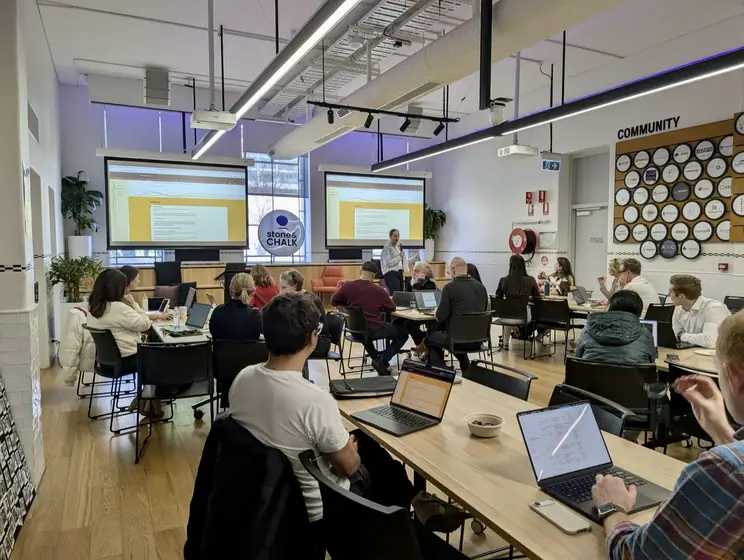
The question nearly always comes at the very end of a scoping call. We've agreed what the workshop covers, who's coming and which tools the team will build with, and then someone goes, 'and... can we claim this?'
For most businesses the answer is generally yes. When a business pays for its team to learn AI, or pays someone for AI strategy or an automation build, and that spend is connected to how the business earns its income, the ATO usually treats it as a deductible business expense. The timing can differ (a custom build is often claimed over several years), and the 120% skills and training boost people still search for ended on 30 June 2024.
A clear disclaimer before the detail. I run AI workshops, and I'm not an accountant or a registered tax agent. This is general information drawn from the ATO's own pages, not tax advice for your business. Your structure, your turnover and what the spend was for all change the answer, so please run it past your accountant before you claim anything.
What does the ATO let a business deduct for staff training?
Training for your staff is generally a normal operating expense, deductible in the year you pay for it. The rule underneath is the general deduction in section 8-1 of the Income Tax Assessment Act 1997, which lets you deduct a 'loss or outgoing' to the extent it is 'necessarily incurred in carrying on a business for the purpose of gaining or producing your assessable income'. The same section rules out anything 'of capital, or of a capital nature' and anything 'of a private or domestic nature', and those two exclusions do most of the sorting in the table further down.
The ATO turns that into 3 golden rules for business deductions: the expense has to be for your business and not private use, a mixed expense is claimed only for the business portion, and you need records to prove it. Its list of operating expenses for business owners includes 'expenses relating to education and technical or professional qualification'. And in the ATO's own worked examples, a business paying for employees' training claims the full cost as 'a business operating expense'.
One detail people miss... if you're registered for GST, you claim the GST on the invoice as a credit on your BAS and leave it out of the deduction.
Is the 120% skills and training boost still available?
No, the small business skills and training boost has ended. According to the ATO's boost page, it covered eligible spending from 7:30 pm AEDT on 29 March 2022 until 30 June 2024, and gave businesses under $50 million aggregated turnover an extra 20% deduction on top of the normal one, which is where the '120%' comes from.
Even while it ran, it was narrower than a lot of the marketing suggested. The training had to be for employees (owners, partners and contractors were out), delivered by a registered training provider, and charged by that provider directly. A one-day AI workshop from a trainer who isn't a registered provider wouldn't have earned the bonus anyway, though it could still be an ordinary deduction. If a website is still promising you 120% back on training you book now, it's out of date.
The companion small business technology investment boost, which gave the same 20% extra on digital spending, finished even earlier, on 30 June 2023.
How are common AI costs treated?
Most AI spending falls into one of the buckets below. This is the general position from the ATO's pages, and your accountant gets the final word on your own invoices.
| What you paid for | How it's generally treated | ATO source |
|---|---|---|
| A hands-on AI workshop for your team | Operating expense, usually deductible in the year you pay, as long as it relates to the work your staff do now | Other operating expenses |
| An AI strategy session for your existing business | Generally an operating expense when it's about running the business you already have. Advice tied to starting a new business can be a capital or start-up expense, which may be claimed straight away or over time | Business deductions |
| A custom automation or AI build | Often in-house software, which is a capital expense. Usually claimed over time (the ATO's example uses a software development pool over 5 years), unless a depreciation incentive applies | Digital product expenses |
| AI software subscriptions such as ChatGPT Business, Claude or Microsoft Copilot | Software subscription fees are an operating expense, claimed in the year you incur them | Digital product expenses |
| A personal AI plan you also use at home | Claim only the business share | Business deductions |
The build row surprises people most. A workshop is something your team does and finishes. A custom automation is closer to an asset your business owns and keeps using, so the tax treatment follows it over a few years. If you're weighing up a workshop, strategy or a build, the three services are laid out on our services page, which makes it easier to see which row each one sits in.
How is a business claim different from self-education?
It comes down to who paid. When the business pays for a staff member's AI course, the business claims it and the employee claims nothing for it. The ATO's self-education page has an apprentice hairdresser called Isaiah whose employer pays his TAFE fees, and he 'can't claim a deduction for the course fees or textbooks because he doesn't incur those expenses, his employer does'. (He can still claim his public transport to TAFE, to be fair to Isaiah.)
When an employee pays for their own course, the individual self-education rules apply instead, set out in the ATO's ruling TR 2024/3. The course needs a 'sufficient connection' to their current job, meaning it maintains or improves skills they need now, or is likely to increase their income from that job. A course taken to get a new job or change careers generally doesn't qualify. So a bookkeeper learning to use AI for reconciliations is on much firmer ground than a bookkeeper studying AI to become a software developer.
Sole traders sit in the middle. You don't have an employer, so your own training is a cost of your business, and the ATO lists education expenses among the things business owners can claim. The same connection test applies though, so it has to relate to the business you run now.
When might AI spending not be deductible straight away?
The two big reasons are capital and private use. A custom build that your business keeps using is usually capital, so the deduction is spread over time. Anything with a private element (the family Claude account, the course your partner did because it looked fun) gets cut back to the business share, or out entirely.
Timing matters too. Training for a business you haven't started yet isn't connected to income you're earning now, so it tends to fall into the start-up expense rules. And spending you prepay for more than 12 months ahead can need apportioning across the service period if it's $1,000 or more, according to the ATO's business deductions page.
What records should you keep?
Keep the invoice, a line on what the training or work was for, and who attended. That covers the ATO's third golden rule, which is that you need records to prove the claim. For a workshop, the agenda and the attendee list do the job. For a build, keep the scope document and the date it was handed over, because your accountant will want to know when it was ready to use.
It's dull admin, I know. Five minutes filing it now beats an hour of digging through emails in July.
And if your accountant comes back with a different answer from this page, believe your accountant (they've seen your books, and I haven't).
Questions people ask
Can I claim the GST on an AI workshop?
If your business is registered for GST and the invoice includes GST, you can generally claim it back as a GST credit on your business activity statement. You then leave the GST out of your income tax deduction, because the ATO doesn't let you claim the same GST twice. If you're not registered for GST, the full amount you paid is generally the figure to work from.
Does the trainer need to be a registered training organisation?
Not for the ordinary deduction. A business can generally deduct training that's connected to earning its income whoever delivers it. The registered training provider requirement belonged to the small business skills and training boost, which ended on 30 June 2024, so it only matters if you're still sorting out claims for spending before that date.
Can a not-for-profit claim AI training as a tax deduction?
Many not-for-profits are exempt from income tax, so a deduction doesn't change what they pay. Some are taxable, and for those the normal business rules apply. If you're on a grant, check whether the grant terms let you spend it on training or AI tools, which is usually the more useful question for a charity or community group.
Is a ChatGPT or Claude subscription tax deductible for a business?
Generally yes, for the business portion. The ATO lists software subscription fees as an operating expense you claim in the year you pay. If one plan is shared between work and home, work out a fair business share and keep a note of how you calculated it. A team or business plan used only at work is simpler to claim in full.
Sources
- Australian Taxation Office, Business deductions
- Australian Taxation Office, Deductions for other operating expenses
- Australian Taxation Office, Deductions for digital product expenses
- Australian Taxation Office, Small business skills and training boost
- Australian Taxation Office, Small business technology investment boost
- Australian Taxation Office, Self-education expenses
- Income Tax Assessment Act 1997, section 8-1 General deductions (ATO legal database)
- Australian Taxation Office, TR 2024/3 Income tax: deductibility of self-education expenses incurred by an individual